Ball Sort Puzzle - Color Game
- 4.9
- Rating
- 50.00M
- Installs
- Free
- Price

 Analysis by App-foxy
I spent time with Ball Sort Puzzle - Color Game as a simple, low-pressure puzzle rather than a game built around a story, characters, or constant action. Its central idea is easy to understand: sort colored balls into tubes until each tube contains a matching color. That sounds modest, but the appeal comes from planning several moves ahead and recovering when an apparently safe move creates a dead end.
It is a free puzzle game from Guru Puzzle Game, aimed at everyone and available for devices running Android 7.0 or later. The game has reached more than 10 million installs, with an average rating of 4.9 from roughly 750,000 ratings and about 10,000 written reviews. Those figures suggest that the format has found a large audience, but they do not remove the need to decide whether this particular style of puzzle suits you. In my experience, the best reason to try it is not its popularity; it is the way a short sorting problem can occupy your attention without demanding a long session.
How the sorting puzzle feels in everyday play
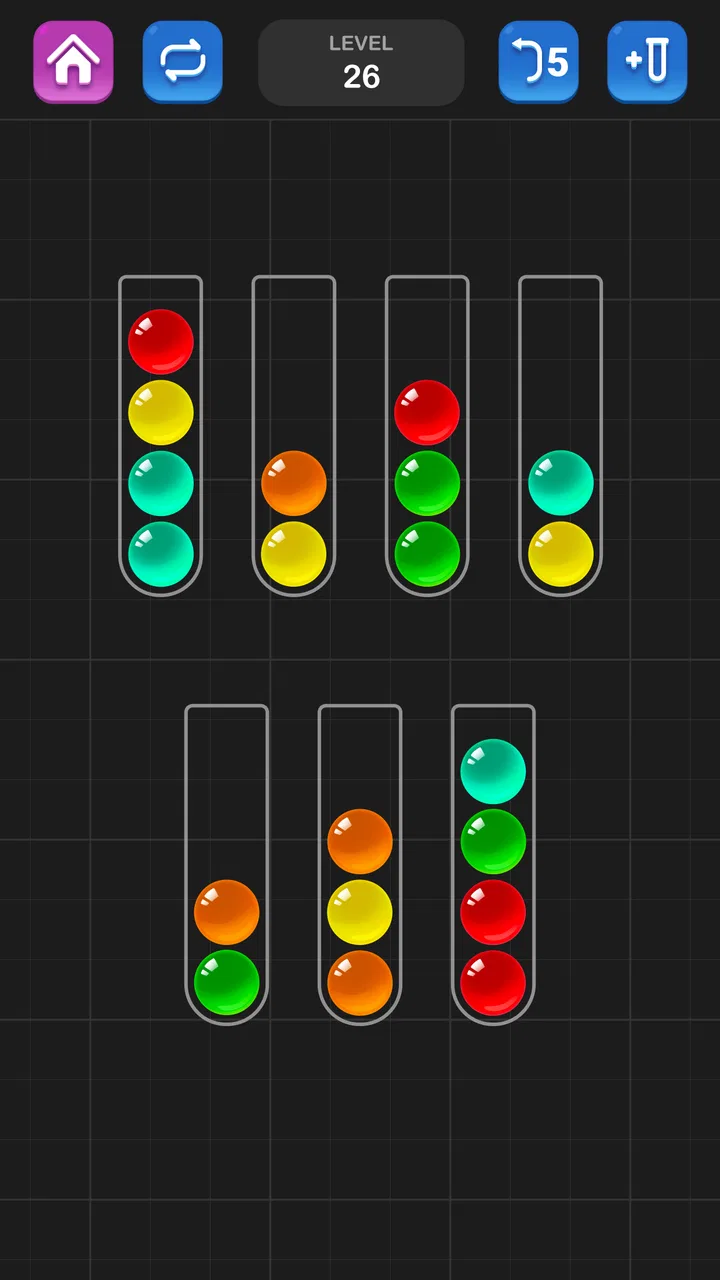
Each level presents a group of tubes containing mixed colors. You tap one tube, then another, and the top ball moves when the destination has room and follows the puzzle’s sorting rules. The objective is to gather identical colors together. The controls are straightforward enough that I could begin playing immediately, but the decisions become less obvious as the available spaces disappear.
You May Also Like

 Blood Strike: 2.5 Anniversary
Blood Strike’s Loadouts Turn Every Drop Into a Tactical Gamble
A close look at Blood Strike’s custom loadouts: how fast access to signature weapons reshapes its battle royale rhythm, rewards preparation, and narrows the gap between fights.

 Pandora - Music & Podcasts
Pandora’s Music Is Easy to Start, but Harder to Recover
Pandora’s strength is its low-effort path from a seed to a station. Its weak spot is how much confidence it asks you to place in connection, setup, and quiet recovery.

 8 Ball Pool
 Is Built on Rivalries, Rematches, and Routine
A close look at the rivalries, rematches, shared routines, and unanswered safety questions that turn a quick pool match into a persistent mobile community.

 Samsung Music
’s Quiet Strength Is Playing What You Already Own
Its reach comes less from spectacle than from dependable access to a personal library. That simplicity is both the app’s strongest retention engine and its ceiling.

 AccuWeather: Weather Radar
AccuWeather Review: A Quick, Clear Forecast for Everyday Decisions
For everyday plans, the best forecast is the one you can understand quickly. AccuWeather makes rain timing, radar, and local conditions easy to act on, with a few trade-offs.

 Hill Climb Racing
Why Hill Climb Racing Still Turns Crashes Into One More Run
A tiny car, a bumpy hill and one more upgrade: Hill Climb Racing keeps resurfacing because its simple chaos makes every near-miss feel personal.
More From Our News Desk
View All News


The first few puzzles work well as a gentle introduction. I could experiment with the order of moves and quickly see why one choice was better than another. Later, the same basic action becomes more interesting because a tube that looks useful may actually be needed as temporary storage. That is the part I enjoy most: the challenge is not recognizing colors, but preserving enough flexibility to finish the arrangement.
A realistic use case is a short break during a commute, while waiting for an appointment, or between two tasks at home. I can complete a few moves, put the phone down, and return without needing to remember a complicated plot or control scheme. It also suits people who like quiet concentration. There is no need to coordinate with other players, learn a large ruleset, or build a long-term collection before the puzzle becomes playable.
The game’s offline play is particularly useful for that kind of routine. I can treat it as a small mental exercise when a connection is inconvenient, rather than as an app that becomes useless outside a reliable network. That does not make every session exciting, but it makes the game easier to keep available for travel and brief pauses.
The real skill is managing empty space
The most useful habit I developed was to stop treating the spare tube as a free dumping ground. An empty tube is valuable because it gives me room to separate colors, but filling it with a color that I cannot soon complete can remove the flexibility I need later. Before moving anything, I try to identify which color is already close to being completed and which tube is blocking access to it.
Another practical technique is to avoid exposing a buried color too early. Moving the top layer may reveal a helpful ball, but it can also split a nearly organized stack and force several extra moves. I usually look for a sequence that combines two goals: freeing a blocked color while placing another ball where it can eventually join its group. This is slower than tapping the first legal move, but it reduces the chance of reaching a position where every tube is awkwardly occupied.
When I make a poor choice, restarting can be more sensible than trying to repair the entire board. A failed position often teaches me which tube was more important than it first appeared. The game works well for this kind of trial and correction because the rules are simple enough to keep the lesson clear. It is not a substitute for a formal logic course, but it does reward patience and sequencing.
What the free version means for value
The game is free to download and play, which makes the initial decision easy: there is no purchase required to discover whether sorting puzzles hold your attention. That matters because this genre is highly personal. Some players find the repeated structure calming, while others feel that arranging colors becomes monotonous after a short time.
There are in-app purchases priced at $7.99 per item. I would therefore judge the free access first and treat any optional spending as a separate value decision. The sensible approach is to play enough to understand whether the basic puzzle loop remains enjoyable before paying for anything. A purchase may feel worthwhile to someone who plays frequently and wants to support continued use, but it is harder to justify for a casual player who opens the game only occasionally.
I also prefer not to describe the paid option as automatically good value simply because the game has a high rating. Ratings indicate that many people enjoy it; they do not tell me how often an individual reader will play or whether a purchase changes that person’s experience enough to matter. For me, the free entry point is the strongest part of the value proposition. The paid side should be considered only after the free experience has earned that consideration.
The game’s current version is 4.2.1, so anyone installing it should check that the device meets the Android requirement and has enough room for ordinary app installation. The age classification is Everyone, which makes it suitable to consider for shared family devices. That classification describes accessibility for a broad audience, though younger players may still benefit from guidance when a puzzle becomes frustrating or when they are learning to plan several moves ahead.
Where the design is strong
The biggest strength is the balance between instantly readable rules and gradually more demanding decisions. I do not need to memorize symbols or learn a complicated interface. Colors communicate the state of the board, and the tube arrangement makes progress visible. That clarity is valuable when I want a puzzle that starts quickly rather than a game that spends its first session explaining systems.
It also offers a different kind of satisfaction from a word puzzle or a number-grid game. In a word game, I search for language patterns; in a number puzzle, I test relationships between digits. Here, I manage physical space and order. That makes it a good alternative for someone who wants structured thinking but does not enjoy vocabulary challenges or arithmetic.
Compared with a match-three game, the experience is less reactive and less dependent on creating chains under time pressure. I can pause and reconsider a move. Compared with a traditional jigsaw app, it gives me a more compact problem with a clear state after every action. And compared with a large strategy game, it removes resource management, combat, and long-term progression from the decision. The trade-off is that the simplicity can become repetitive if I want variety in theme or mechanics.
The offline capability strengthens that comparison. A match-three title may be designed around frequent events, changing goals, or online-connected services, while this game’s appeal is more self-contained. For a reader who wants a dependable mental break without committing to a social or competitive environment, that difference is meaningful.
Limitations I noticed while playing
The same simplicity that makes the game approachable can limit its long-term appeal. The core action remains sorting colored balls into tubes, so players who need a constant stream of new mechanics may eventually feel that the format is too narrow. I would not choose it as my main game if I wanted a story, character development, multiplayer interaction, or a broad range of puzzle types.
Color recognition is also central to the experience. That is normally helpful, but players with difficulty distinguishing certain colors may find some boards less comfortable to read. The game’s concept depends on identifying which balls belong together, so visual clarity matters more here than it would in a puzzle based mainly on text or numbers.
There is a mental rhythm to the levels that will not suit everyone. I enjoy the quiet pause before a move, but someone looking for fast feedback may find the game slow. Likewise, a player who dislikes restarting after a mistake may become irritated when a sequence leaves too little room to recover. The game rewards planning, yet it does not turn every mistake into an interesting new challenge; sometimes the practical answer is simply to begin the board again.
Another trade-off is that a very simple interface can offer little guidance when I am stuck. The rules are easy, but knowing the best next move is not always obvious. I find that useful because it preserves the puzzle, but readers who want generous hints or constant assistance should consider whether they prefer a more guided alternative.
Who will get the most from it
I would recommend it first to people who enjoy logic puzzles in small portions. It works especially well for anyone who likes arranging, grouping, and planning but does not want a demanding schedule of daily tasks. The free starting point also makes it a practical choice for trying the genre without committing money at the outset.
It may appeal to families because the age rating is Everyone and the rules can be explained quickly. A parent and child could discuss possible moves together, with the adult asking which tube should remain empty or which color is easiest to finish. That turns a solitary puzzle into a small conversation about planning without requiring competitive play.
It is also a good fit for adults who want a distraction that does not require sound, a stable connection, or a long uninterrupted session. I can play with one hand during a short pause and stop when the task in front of me begins again. The game’s value in that situation comes from convenience and focus rather than from a large amount of content.
I would be more cautious about recommending it to players who quickly tire of repetition. If your ideal puzzle app changes rules regularly, introduces elaborate environments, or gives you a strong sense of narrative progress, this one may feel too focused. A non-color-based logic game may also be better if distinguishing similar shades is uncomfortable for you.
How to play more thoughtfully
My preferred approach is to inspect the whole board before making the first move. I look for a color that can be completed with minimal disruption, then identify which tube must stay available as a workspace. This small pause prevents the common mistake of using every empty space immediately.
I also try to build partial groups only when they help reveal or receive another matching ball. A stack that looks tidy is not always useful if it traps a different color underneath. In other words, visual neatness is not the same as progress. The best move is often the one that keeps future options open, even if the board looks messier for a moment.
For short sessions, I recommend stopping after a frustrating failed attempt instead of forcing the puzzle. Because the game is easy to reopen and play offline, there is little benefit in turning a relaxing activity into a test of endurance. Returning later can make the arrangement easier to see, and the game’s low commitment supports that habit.
If you are considering an in-app purchase, I would use the same practical test: ask whether the free version has become a regular part of your routine. Since each item costs $7.99, the purchase should be judged against your actual playing frequency, not against the size of the install count or the rating. Occasional players can reasonably remain with the free experience, while frequent players can decide whether the added value is meaningful to them.
My final decision
Ball Sort Puzzle - Color Game is a focused, accessible puzzle for people who enjoy sorting and forward planning. Guru Puzzle Game keeps the central idea uncomplicated, and that makes it easy to recommend as a free trial for anyone curious about the genre. The offline option, Everyone age rating, and support for Android 7.0 or later also make it convenient for a wide range of everyday situations.
My recommendation is strongest for short, quiet sessions: waiting rooms, travel, breaks between chores, or any moment when I want my attention occupied without starting a large game. The free access gives it a fair chance to prove itself, while the $7.99 in-app purchase price means I would postpone spending until I knew I played often enough to benefit.
My honest verdict is to try it, but not to expect endless variety. If the pleasure of finding a safe sequence and preserving empty space keeps you interested, this is a clean and satisfying choice. If you need stories, social play, rapidly changing mechanics, or a puzzle that does not rely on color grouping, I would skip it in favor of a different category. For the right player, however, the modest design is precisely the point: it turns a few spare minutes into a small problem worth solving.
FAQs for Ball Sort Puzzle - Color Game
01What is Ball Sort Puzzle - Color Game?
Ball Sort Puzzle - Color Game is a fun and challenging puzzle game that tasks players with sorting colored balls into their respective tubes. The goal is to have all balls of the same color grouped together in a single tube. It's a fantastic exercise for the brain, requiring strategic thinking and planning.
02How does the gameplay work in Ball Sort Puzzle?
In Ball Sort Puzzle, you are presented with several tubes filled with balls of various colors. You need to move the balls between tubes, aiming to group all balls of the same color in one tube. The game becomes more challenging as you progress, with more colors and tubes added to the mix.
03Is Ball Sort Puzzle free to play, and are there in-app purchases?
Ball Sort Puzzle is free to download and play on both Android and iOS platforms. However, the game does offer in-app purchases. These purchases can help remove ads or provide additional moves and hints, enhancing the overall gameplay experience without waiting or replaying levels.
04Can you play Ball Sort Puzzle offline?
Yes, Ball Sort Puzzle can be played offline. This makes it an excellent choice for those moments when you don't have access to Wi-Fi or data, such as during travel. However, some features, like in-app purchases or social sharing, may require an internet connection.
05What are the unique features of Ball Sort Puzzle?
Ball Sort Puzzle offers unique features like hundreds of levels with increasing difficulty, a simple yet engaging interface, and the ability to undo moves. The game also provides hints to guide players through challenging levels, making it accessible to both casual and experienced gamers.
Pros
- Engaging and addictive gameplay.
- Simple controls for easy play.
- Visually appealing color design.
- Challenging levels increase skill.
- Suitable for all age groups.
Cons
- Ads can be intrusive.
- Lacks multiplayer mode.
- No hints for difficult levels.
- Limited customization options.
- Progress can be slow without purchases.

Ball Sort Puzzle - Color Game
Gallery